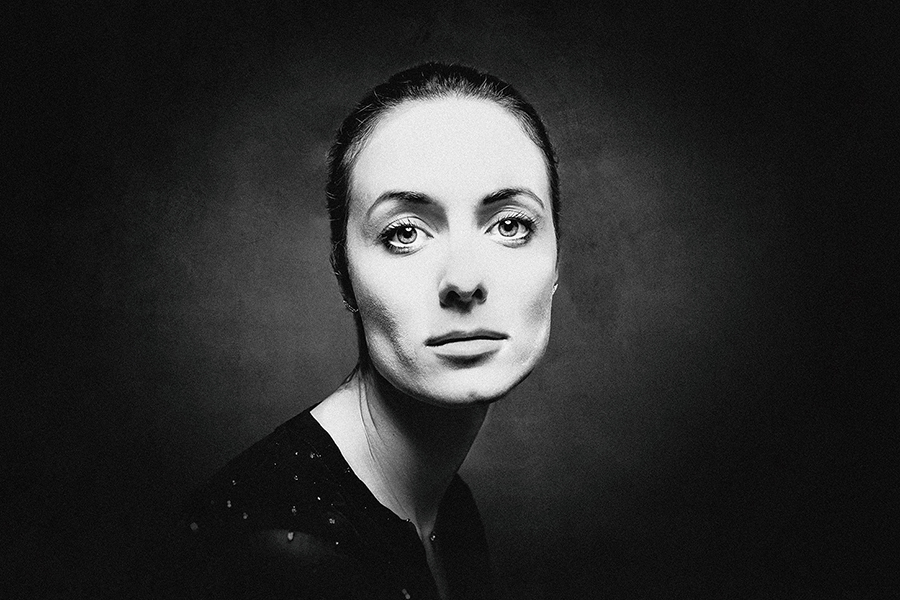
Image Kindly Yannick Faure with the art work “Aurore”.
CHAPTER ONE
Sydney. Summer. The heat is a white sheet, relentless and bleaching. He walks. On his path, there are no cats—only frenetic lizards darting across scorched stone. At Turramurra station, he finds the train. He sits and feels the compartment’s cool embrace. Around him, the faces are down, swallowed by their phones. Outside, at Lindfield, a snake nibbles in the unknown. Michael’s breath is light and easy. His mind is quiet. He is absorbing all. Earlier, in the cool dawn: the Buteyko breathing, The View From Above, the Memento Mori meditation. He is aware.
Roseville station. A young woman sits opposite. Red lips. She touches her hair, shifts her legs. On her right knee, pink birthmarks. They match her tight skirt. Her legs are long and elegant. He cannot stop watching the birthmarks; they change as she moves, a shifting geometry in the white heat. The train moves on from Roseville. The young woman stands to leave, her long legs straightening. The pink birthmarks on her right knee stretch, becoming thin lines of color before they disappear as she steps onto the platform. The red lips vanish into the white glare of the station.
Michael remains. His mind is a still pool. The “frenetic lizards” of the morning are far away. He is the only one in the carriage not tethered to a screen. He is anchored by the light breath in his lungs and the Memento Mori in his marrow. He watches the “unknown” outside the window. The Sydney heat continues to beat against the glass, relentless and white, but inside the silence of his mind, the music has already begun.
The train descends into the dark. Town Hall. The doors slide open. The “frenetics” surge out, a river of bodies rushing toward the turnstiles. Michael rises, his movement fluid, his breath still light. He leaves the cool compartment and steps onto the platform. The heat is waiting at the top of the stairs, thick and white. He walks into it, absorbing the noise and the grit, a man apart.
The Gallery of New South Wales. The destination. His legs move with a lightness that defies the pavement. He does not fight the white heat; he wears it. An old lady passes. She carries an umbrella against the glare. Her hair is a deep, beautiful white, worn long—a silver silk against the sun. She smiles. Her eyes are old maps, lived well, etched with an understanding that needs no words. Another smile. A silent exchange in the relentless light. Michael absorbs it, his mind quiet, his breath easy.
The Gallery. Cool and elegant. Inside, the tired people rest. They drink, they think, they watch the walls. Michael moves through them, a ghost in the shade. He walks across the stone and descends the mobile stairs. This is the place. The meet-up. He is early. He introduces himself. He sits. The table is long, cold, and in a line.
The others arrive. They fill the seats along the cold, straight line of the table. The rules are read. Cold. Unnecessary. For a moment, Michael wonders why he is here. The thought is short, a flick of a lizard’s tail, then he returns to his destiny. The man beside him begins to talk. He is driven by ego, yet he says nothing. He hunts for acceptance in the eyes of the others, his voice a mask for the fear beneath. He projects confidence like a flickering shadow, unaware of his own sadness. Then, he stops. A pause follows. It is uncomfortable for the others. For Michael, it is music. It is telling. He is not waiting to speak; he is listening to the silence.
The talk starts again. Trump. Albanese. AI. Surface noise. They avoid the things they truly want to talk about. Michael is the only one who does not offer words to the pile. Another pause. The music returns. Some eyes turn toward Michael, waiting, but he remains still. He is listening. There is no need to talk.
Then she talks. Slowly. She moves her cup—a deliberate, weighted motion. It is the same way her father moved, with a confidence that claims the space, a purpose that brooks no argument. She is elegant. She is poised. Italian. But beneath the artifice of the long, cold table, the truth emerges. The pain. The father. The son. The geometry of her struggle. She is honest now, startling . She screams for love, not with her voice, but with the raw vibration of her presence. She wants to be loved the way she deserves, stripped of the “ego fog” and the “rectangular” rules of the room. The music in the pause becomes a bridge.
Now Michael knows why he is here. The name is Giorgia. Michael talks. He offers no surface noise. He gives her the “naked truth.” He thanks her and says that he loves her. It is a love of the “Half-God”—not clumsy, not grasping. It is a protective, caring weight. It feels different. Better. He feels the truth of it in his light breath.
Giorgia smiles. Her lips are languid, moist with the juice of the moment. For a heartbeat, the “Real Music” plays. Then, the “Ghost House” returns. The fear settles back onto her face like soot. She does not trust. The father’s shadow falls across the long, cold table. The memory of the belt, the abuse, the hands that should have protected but only struck. Michael sees the struggle. He loves her more for it, and he says it again. The words are a mirror.
Giorgia pushes back. It is a strong, violent rejection—the same rigid, aggressive force her father used. She is using the abuser’s armor to protect the girl who is screaming for love. Michael knows. The geometry of the moment is set; he is going to lose her. His love is unconditional, a weightless anchor. He explains the illusion to her—the “Ghost House” she lives in, the father’s belt that still defines her world. He wants to save her from it. He offers the key: Forgiveness. Without it, there is no release, only the repetition of the pain.
Reality is a jagged thing. She still loves him. He can see it in the languid lips, the juice, the way she looks at him. But love is pure and destructive at the same time. Because there is no forgiveness for the past, there can be no future for anyone. It is too much. The “Scream” is too loud. Michael sits at the long, cold table and accepts the Memento Mori of the relationship. No other way.
Giorgia stands. She does it with the same grace she used to move the cup—purposeful, elegant, carrying the father’s confidence like a shroud. She turns and walks away, back toward the mobile stairs. Michael does not move. He watches her. He follows the line of her back, the rhythm of her step, watching all the way until she disappears into the white light of the upper gallery. He has lost her. The silence that remains is not music; it is a void.
Michael lost his balance. His breath is unstable. He hears voices in the background. He is in pain. The talk continues. Insignificant. Like mockery. Michael is silent. He gets up and will never return. He needs to talk, to understand. He cannot talk to anyone but Zeus.
TAGS: Miracles and Illusions, Modern Fiction, Psychological Drama, Memento Mori, Buteyko Breathing, Contemporary Literature, Sydney Summer.