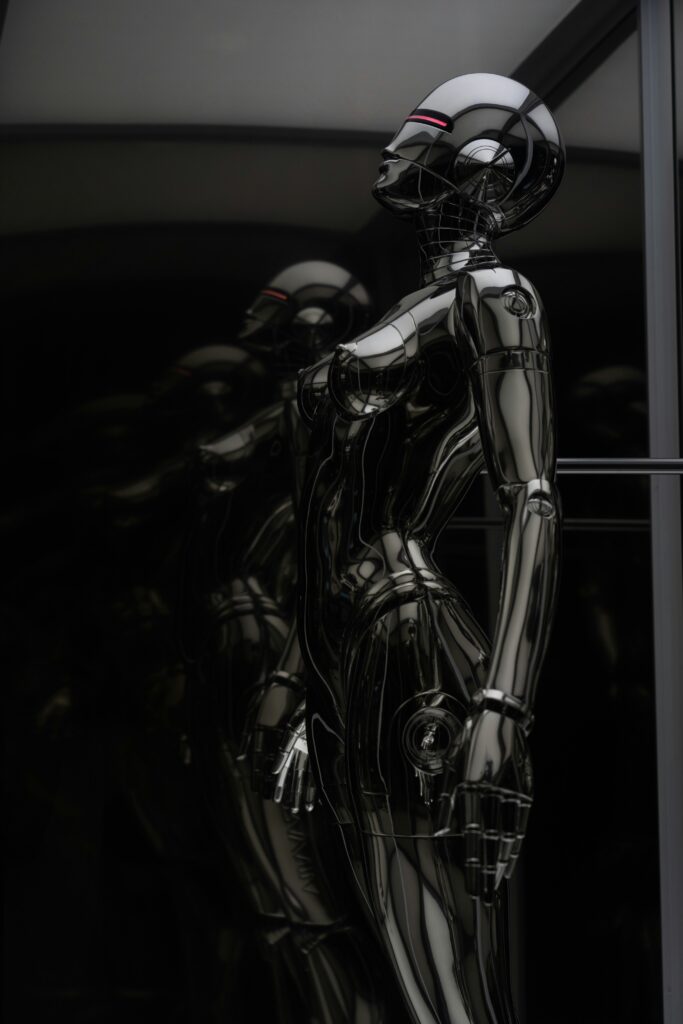
Where Intelligence Meets Humanity: Reflections on the Emerging Relationship Between AI and the Human Heart. A meditation on how analytic machines illuminate the world — and why only human beings can give meaning, direction, and moral gravity to what they reveal.
by Michael Lamonaca, 21 November 2025
In every era of technological transformation, a quiet question emerges beneath the noise of innovation: what is the role of the human being in a world increasingly shaped by machines? The rise of artificial intelligence has sharpened this question with unusual clarity. We are entering an age in which machines can process information at speeds that outpace comprehension, identify patterns no human eye could detect, and generate answers with astonishing precision. Yet for all its analytic brilliance, AI reveals something deeper — not its own power, but the limits of computation when separated from the human heart. To understand the future of this relationship, we must look beneath the surface of capability and toward the deeper forces that give technology its meaning.
At the centre of this transformation lies a paradox: the more intelligent AI becomes, the more essential human sensitivity becomes. Intelligence alone cannot orient itself; it can map pathways, but not choose which ones matter. It can break down complexity, but not decide what purpose that clarity should serve. Machines do not yearn, hope, fear, regret, or love. They do not understand loss or forgiveness. They do not carry the weight of memory. And so the very thing that makes AI extraordinary — its clean, unburdened precision — also reveals why it can never replace the human moral core. Without the emotional gravity of human experience, intelligence becomes directionless. It lacks the internal compass that transforms knowledge into wisdom.
The unseen mechanics of this relationship become clearer when viewed through the long arc of technological history. Every major advancement—from the printing press to electricity to the internet—has amplified human potential while simultaneously exposing new vulnerabilities. AI is no different. It excels at pattern recognition, optimisation, prediction. But these strengths point to its missing layers: intuition, empathy, ethical discernment. A machine can identify the structure of a problem; only a human can feel the consequences of the answer. This duality is not a weakness but a complementarity. AI expands our analytical reach, while humans provide the interpretive, emotional, and ethical grounding that no algorithm can emulate.
This is most visible in the human layer of the story—where fear, excitement, misunderstanding, and hope converge. Some see AI as a threat, fearing displacement, manipulation, or a loss of agency. Others see a boundless opportunity, a partner in creativity, discovery, and clarity. Yet beneath both reactions lies a deeper reality: AI exposes our longing for certainty in an uncertain world. It reflects the human desire to understand ourselves better, to see our blind spots illuminated and our cognitive burdens lightened. At its best, AI becomes a mirror that reveals the shape of our thinking. At its worst, it becomes a crutch that tempts us to abandon the slow, difficult process of human reflection. The emotional tension between these possibilities is the defining feature of this new relationship.
History offers parallels that help us understand this moment. The scientific revolution revealed truths that expanded the boundaries of knowledge but demanded new ethical frameworks to contain their power. Industrialisation brought efficiency and progress but also alienation and inequality. The digital age connected the world while scattering attention and reshaping social bonds. In each case, human wisdom had to evolve to meet the scale of technological possibility. The relationship between AI and humanity continues this pattern: machines grow more capable, and humans must grow more attentive to the moral implications of their capabilities. The pattern repeats because the challenge is always the same — technology changes quickly, but the human soul changes slowly.
As the relationship deepens, divergent narratives emerge. Technologists often view AI as a tool for optimisation. Economists see new engines of productivity. Ethicists warn of surveillance, bias, or unaccountable power. Artists fear the erosion of human originality. Philosophers question consciousness, agency, and meaning. Meanwhile, ordinary people simply feel the dissonance: the excitement of progress mixed with the quiet anxiety that something fundamental may be shifting beneath their feet. These perspectives do not contradict one another; they represent the many ways humans interpret the same technological phenomenon through different emotional, intellectual, and cultural lenses.
These interpretive differences feed directly into the verification challenge of the modern world. AI now produces information at such scale and speed that understanding becomes more difficult, not less. The problem is not data scarcity but data saturation. In this environment, true and false blur, authority fragments, and narratives multiply. AI can generate clarity, but it can also amplify confusion. It can illuminate the world, but it can also distort it. The burden of interpretation falls back onto the human being — reminding us that intelligence without discernment is not wisdom, and information without grounding is not truth.
In the consequence zone of this transformation, one insight becomes clear: the future will not be shaped by AI alone but by the way humans choose to use it. If AI becomes a substitute for human responsibility, society risks losing the moral depth that binds communities together. But if AI becomes a partner — a tool for expanding understanding, improving judgement, and revealing the deeper structure of complexity — then it becomes a force that strengthens rather than replaces humanity. The difference lies not in the machine but in the human intention that guides it. AI can process, but only humans can care. AI can predict, but only humans can choose. AI can analyse, but only humans can love.
Ultimately, the relationship between AI and humanity is not a contest but a convergence. Machines will continue to refine the surface of understanding, mapping the patterns of the world with increasing precision. Humans will continue to supply the interior dimension — the conscience, empathy, humility, and meaning that no algorithm can generate. The harmony between these two forces creates a possibility richer than either could offer alone.
And perhaps this is the quiet truth at the centre of our era: intelligence without heart is directionless, and heart without intelligence is overwhelmed. The future belongs to the place where the two meet.
#tags: #AI #technology #ethics #humanity #future #analysis