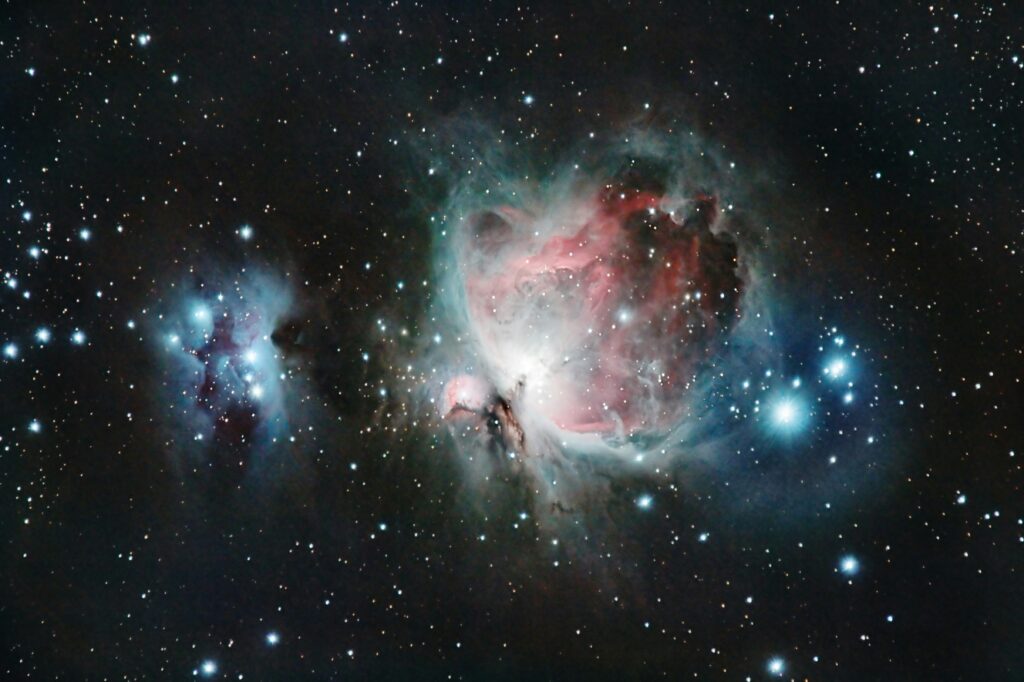
Image by arnaud-mariat unsplash
Listen to the audio version of this article
The Great Reversal: Why the Big Crunch is Modern Physics’ Last Hope Exploring the cosmic shift from eternal expansion to a grand reset
by Michael Lamonaca, 29 December 2025
Why would the world’s leading astronomers be “excited” by the possibility of the universe collapsing in on itself? The death of the “Big Rip” theory doesn’t signal a dark end, but rather the birth of a new physics that finally reconciles Einstein’s equations with the chaos of the quantum world. If the universe has already begun to slow down, as the South Korean team suggests, we are not living in a dying expansion, but in the first moments of a grand cosmic reset. We are standing at the edge of a paradigm shift where the “end of everything” might actually be the greatest story of survival in the history of science.
The “Standard Model” of cosmology has long relied on the Cosmological Constant—a fixed, unchanging energy of empty space that acts as a permanent accelerator. For twenty-seven years, this constant was the “holy grail” of physics, used to explain why galaxies weren’t just moving away from us, but doing so faster every second. This energy was supposed to be a fundamental property of the vacuum, a ghostly push that would eventually leave the universe cold, dark, and hollow. However, the deep forces now coming to light through the Yonsei University study suggest that dark energy is not a constant at all. Instead, it appears to be a dynamic field—often called quintessence—that can strengthen or weaken over eons. This is a radical departure from the static universe described in modern textbooks.
The distinction between these two models is not merely academic semantics. The Cosmological Constant treats dark energy as a property of space itself—everywhere, always, unchanging. Empty space has pressure. That pressure pushes outward. Forever. Quintessence, by contrast, treats dark energy as a scalar field permeating the universe like an invisible fluid whose pressure can vary across time and space. Think of it as the difference between a concrete foundation (constant) and ocean currents (quintessence). One is structural and permanent; the other is dynamic and responsive to the universe’s evolution. If quintessence is real, then dark energy has a history—it was stronger in the past, weaker now, and will continue to decline until gravity’s inward pull overcomes it entirely. This transforms cosmology from a study of fixed laws into a study of cosmic biography, where the universe ages and changes character across epochs.
If dark energy is weakening, the structural integrity of the “ever-expanding” universe begins to crumble. We must look at the vacuum of space not as a static backdrop, but as a fluid medium that is losing its outward pressure. When the outward push of dark energy drops below the threshold of the inward pull of the universe’s total mass, the fundamental geometry of space-time shifts from Open to Closed. This is the invisible pivot point where the expansion of billions of years begins its multi-billion-year U-turn, a transformation that changes the very nature of time and distance as we perceive them. The mathematics governing this transition were worked out decades ago, but they were filed away as theoretical curiosities when the 1998 supernova data seemed to confirm eternal acceleration. Now those equations are being pulled from the archives, dusted off, and scrutinized with the urgency of engineers discovering a structural flaw in a skyscraper that’s already built.
Behind these equations is Professor Young-Wook Lee, who famously likens our current understanding of the universe to doing up a shirt with the first button fastened incorrectly. For Lee and his team, the mistake happened in 1998, when the initial supernova data failed to account for the age bias of galaxies. They argue that younger stars produce slightly dimmer explosions than older ones, a detail that was missed in the excitement of the initial discovery of acceleration. If Lee is correct, the 2011 Nobel Prize in Physics was awarded for an illusion created by stellar evolution. This creates a fascinating tension within the scientific community, pitting the established legacy of the last three decades against a new wave of statistical scrutiny that refuses to be ignored.
On one side of this debate, you have the “Old Guard” who built their careers and reputations on the idea of an accelerating cosmos. Entire research programs, billions in telescope funding, and hundreds of doctoral theses rest on the foundation of the Cosmological Constant. On the other, you have a new generation of data-driven rebels willing to say the emperor has no clothes. The human factor here is one of high-stakes academic survival; to admit Lee is right is to admit that the last quarter-century of cosmological theory was built on a misunderstood Standard Candle. This isn’t just a scientific disagreement; it is a battle for the soul of modern astronomy, where the winner dictates how the next century of space exploration is funded and focused. The personal stakes are enormous—for the Old Guard, vindication of life’s work; for Lee’s team, scientific immortality or permanent marginalization depending on which way the data breaks.
The idea of a Big Crunch is not a new invention; it was actually the dominant scientific and philosophical expectation until the late 1990s. Before dark energy was discovered, it was widely assumed that the Big Bang’s initial momentum would eventually be countered by gravity, leading to a Big Bounce or a cyclic universe. This mirrors the historical transition in the 17th century when the Ptolemaic model was replaced by the Copernican model. In both cases, messy data—like the retrograde motion of planets or the variation in supernova brightness—was ignored or corrected with complicated layers of theory until the primary foundation became too significant to dismiss.
Today, the “messy data” is the supernova age-bias, and it is forcing a return to the cyclic theories of the early 20th century. Just as the Copernican revolution forced humanity to accept that we aren’t the center of the universe, the Big Crunch revolution may force us to accept that the universe is not a one-way street. Instead, it may be a repeating pulse—a cosmic heartbeat that has likely happened many times before, each collapse providing the fuel for a new beginning. This perspective shifts the universe from a terminal machine to a living, breathing cycle that defies the finality of death. The pattern is familiar to anyone who has watched scientific consensus shift: initial certainty, accumulating anomalies, defensive elaboration of the existing model, then sudden collapse when the weight of contradiction becomes unbearable. We may be living through that final phase now, the moment before the paradigm breaks.
The tension between the standard model and these new findings is measured in sigmas—the statistical gold standard for determining if a discovery is a fluke or a fact. While the Yonsei team claims a 99.999% confidence level for their age-bias correction, mainstream critics argue that the correlation with age is not very tight. The debate centers on whether we can trust Type Ia Supernovas as universal measuring sticks. Critics like Professor George Efstathiou argue that stellar explosions are too complex to be treated as uniform values, suggesting that the South Korean team is seeing patterns in the noise. This creates a verification deadlock that can only be broken by a massive increase in observable data.
The mainstream view relies on the sheer volume of past papers and the mathematical elegance of the Cosmological Constant, while the new view relies on a singular, massive statistical correction that threatens to topple the entire house of cards. This standoff is currently playing out in the pages of prestigious journals, where every decimal point in a supernova’s light curve is scrutinized as if the fate of the universe depended on it. In a very real sense, it does. If the sigmas continue to trend in Lee’s favor, we are on the verge of the most significant retraction in the history of physics. The challenge resembles trying to determine whether a massive ship has begun to slow down by measuring the wake from a lifeboat a mile behind it—you need extraordinary precision across vast distances and timescales to detect a change that’s happening too gradually for any single observation to capture.
Proving that dark energy is weakening requires a system-wide test that only the next generation of massive telescopes can provide. The Dark Energy Spectroscopic Instrument in Arizona has already provided hints that the expansion rate is fluctuating, but it hasn’t reached the threshold needed to officially dethrone the Cosmological Constant. The current generation of instruments can observe supernovas out to about 10 billion light-years—impressive, but insufficient to map the entire acceleration history of the universe with the precision needed to detect weakening dark energy. What’s required is a complete census of cosmic expansion across 13 billion years, from the universe’s infancy to the present day.
The technical challenge is formidable. Type Ia supernovas are rare—only a few explode per galaxy per century. To build a statistically robust map of cosmic expansion, astronomers need to observe tens of thousands of these explosions across billions of years of cosmic history. Each supernova must be measured with extraordinary precision, accounting for dust, gravitational lensing, and the age bias that Lee’s team identified. Current telescopes can capture a few hundred usable supernovas per year. The Vera C. Rubin Observatory, scheduled to begin operations in 2025, will observe thousands per year, revolutionizing the statistical power available to test competing models. The Nancy Grace Roman Space Telescope, launching in 2027, will peer even deeper into cosmic history with infrared sensitivity that cuts through dust and captures the most distant explosions.
Until these instruments come online and accumulate years of observation, we are in a state of scientific limbo. The most important question in physics remains a matter of interpretation rather than proven fact, leaving a vacuum where both an eternal freeze and a violent collapse remain on the table. This uncertainty is what fuels the current ferment in the scientific community, as researchers race to be the first to confirm the true nature of the force that dictates our destiny. The stakes are nothing less than the roadmap for the future of the human species. If dark energy is truly weakening, we have perhaps trillions of years before collapse—time enough for civilizations to rise, fall, and engineer survival strategies we cannot yet imagine. If it remains constant, we face an emptier, lonelier fate.
If the Big Crunch is true, the universe avoids the most depressing fate imaginable: the Heat Death. In the Heat Death scenario, galaxies drift so far apart that they disappear from each other’s view, stars burn out, and the universe becomes a cold, dark void for trillions of years. It is a slow, lonely expiration that renders all information and life ultimately meaningless. The final state is maximum entropy—every particle evenly distributed, every temperature equalized, every process ground to eternal stillness. Nothing happens, nothing can happen, and nothing will ever happen again. It is the ultimate victory of thermodynamic decay over structure, life, and meaning.
The Big Crunch, by contrast, is a violent but generative ending. As space-time contracts, the Cosmic Microwave Background radiation would blue-shift and heat up, eventually becoming hotter than the surfaces of stars. Galaxies would merge in spectacular collisions. Black holes would consume everything in their path before being dragged into a final gravitational maelstrom. Temperature and density would climb without limit, recreating conditions similar to the first moments after the Big Bang. In this scenario, the universe doesn’t fade—it roars back into a state of pure energy and possibility.
The prospect of a collapse is, paradoxically, the most optimistic outcome for the universe. It suggests that our existence is not a freak accident in a dying void, but a participant in a grand, recurring symphony. As galaxies merge and space-time contracts back toward a singular, infinitely dense point, the conditions for a new Big Bang are recreated. For many physicists, this is the Last Hope because it allows for a Big Bounce—the idea that our end is simply the ignition for the next chapter. It provides a sense of continuity that the standard model lacks, transforming the cosmos from a tragedy into an epic. The cyclic universe offers something the Heat Death cannot: redemption through renewal. Information may not be preserved across bounces, civilizations will not survive the transition, but the capacity for structure, complexity, and life to emerge again remains intact. The universe becomes not a tomb but a phoenix.
The possibility of a Big Crunch suggests that we are not drifting into a lonely, desolate void, but are part of a rhythmic, living system that may have no beginning and no end.
Tags: Cosmology, Dark Energy, Big Crunch, Quintessence, Physics, Scientific Paradigm Shifts